
Ranking Popular Training Cues (From Worst to Best)
Jan 22, 2026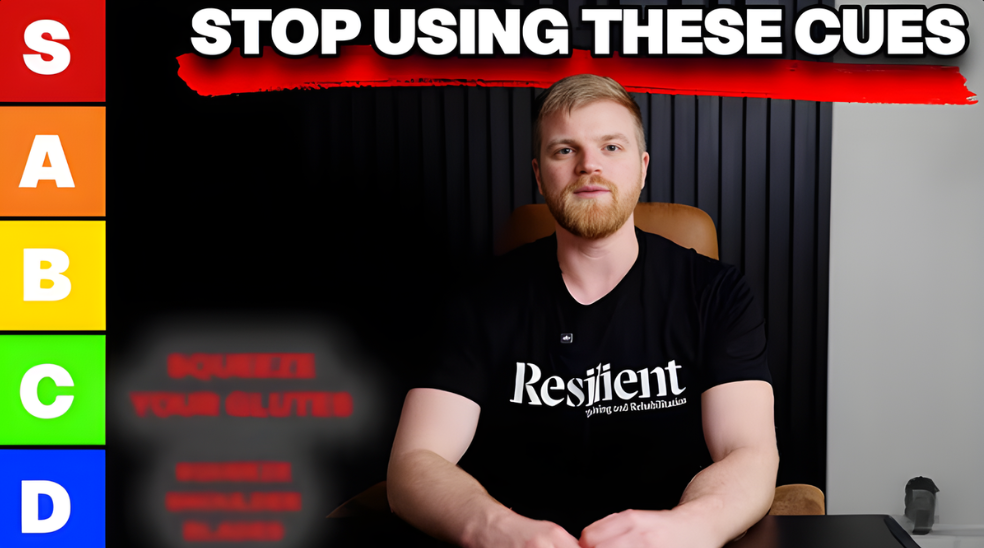
Training cues are meant to put someone in a better position so the exercise can actually do its job.
But not all cues do that.
Some cues are neutral, some are outdated and some actively push people into compensations that limit progress or create pain.
That's why in this blog, I'm going to be ranking several common training cues from least effective to most effective and breaking down what they actually do from a biomechanics standpoint.
Why most cues fail
A key principle to understand before ranking cues is this:
If the joint is not in the right position, the muscle cannot contract effectively.
Many popular cues focus on trying to force a muscle to work harder instead of improving the position that would allow that muscle to work naturally.
When position is off, people compensate through the spine, ribs, or surrounding joints. That is where most issues begin.
Cue #1: “Squeeze your glutes”
D-tier
This cue is extremely common during glute bridges, deadlifts, and hinge-based exercises.
It is usually given when someone says they cannot feel their glutes working.
The issue is that squeezing harder does not fix poor pelvic position.
If the pelvis is tipped forward and the femur is already pulled back, the glutes are shortened and cannot contract well. In that position, people often compensate by extending their knees first or arching through their lower back.
A better approach is to cue position instead of contraction.
For hinges, a more effective cue is:
-
Keep the knees slightly bent
-
Keep the knees forward as the hips come through
This allows the pelvis to move over the femur instead of forcing knee extension first. That opens space at the back of the hip and places the glutes in a position where they can actually contribute.
Cue #2: “Squeeze your shoulder blades together”
D-tier
This cue is often used during rows or pressing to address rounded shoulders or poor posture.
What usually happens instead is rib flare.
When someone squeezes their shoulder blades together, they often push their rib cage forward and arch their spine. The shoulders move back, but not because the upper back muscles are doing their job.
This reduces leverage for the middle traps and rhomboids and places the shoulder in a position that does not move well in the joint.
Over time, this can contribute to pinching or irritation in the front of the shoulder, especially during pressing movements like bench press.
A more effective strategy is to set the rib cage and create a stable, rounded surface for the shoulder blades to move around.
One effective cue is:
-
Push through the feet
-
Lean back between the shoulder blades while staying tall
From there, the arms move back and the shoulder blades glide naturally without being forced together.
Cue #3: “Knees forward”
Effective when paired correctly
Driving the knees forward can be a very effective cue, depending on how it is used.
When the knees move forward, space opens between the femur and the sit bone. This space is critical for hip internal rotation, hip flexion, and proper hinging mechanics.
This cue is especially helpful for people who carry excessive tension in the back of the hips or who struggle to access hip rotation.
However, knees forward on its own is not enough. It needs to be paired with the right hip cue to prevent people from simply pushing the pelvis forward or squeezing into extension.
Cue #4: “Knees forward, hips up”
S-tier
This is the most effective cue because it addresses multiple biomechanical needs at once.
-
Knees forward opens space at the back of the hip
-
Hips up encourages the pelvis to hinge instead of pushing back
-
The glutes lengthen before they contract
-
The pelvis can move without compensating through the spine
Instead of cueing “push your hips back,” this cue keeps the knee relatively fixed while the pelvis lifts and hinges upward.
This is especially effective for deadlifts and hinge patterns where people tend to overbrace, overextend, or rely on their lower back.
The bigger takeaway
Most cueing problems aren't muscle problems.
They're position problems.
When you improve position, muscles usually do what they are supposed to do without forcing them.
If you are constantly adding more cues and getting less result, it is usually a sign that the underlying position has not been addressed.
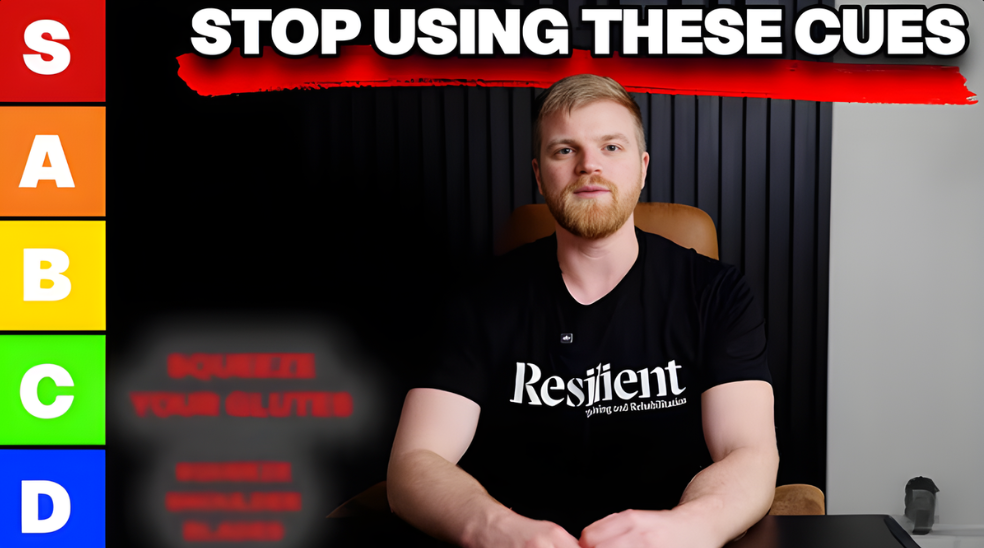
I go even further in these breakdowns and alternative cues over on YouTube. Head here to watch the video.
Want to go deeper?
If you want to:
-
Understand which cues work best for specific exercises
-
Learn how to progress movements based on compensation patterns
-
Stop guessing and start selecting exercises with purpose
The Roadmap to Exercise Selection breaks down over 50 exercises, explains what each one does, and shows you how to choose the right tool at the right time.
This is how you move from cueing randomly to coaching with precision.

