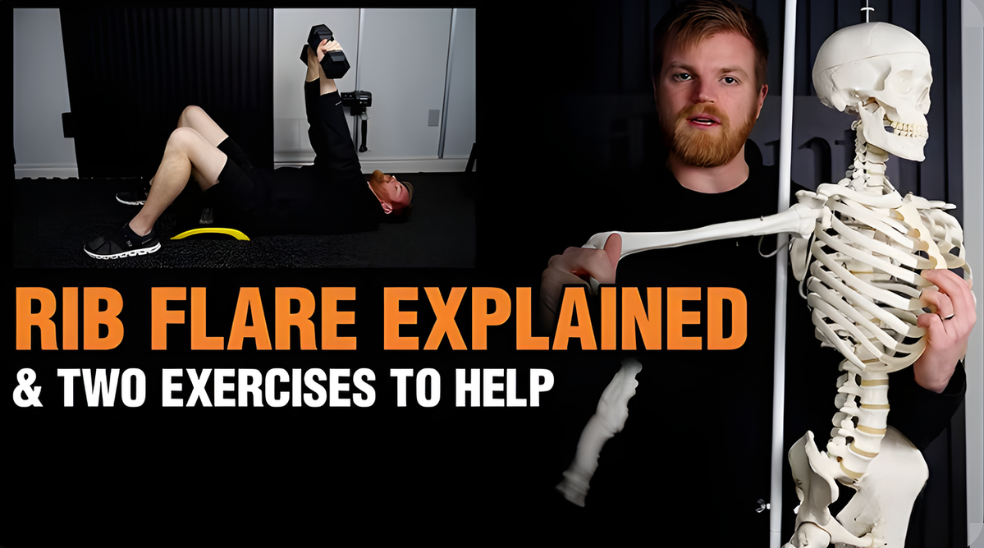
If you’re trying to fix rib flare, it helps to understand why it’s happening in the first place.
We see ribs popping up and assume it’s one issue, but rib flare isn’t a single pattern- it’s a position that can show up for different reasons. If you don’t separate those reasons, you’ll end up chasing symptoms instead of fixing the root.
Let’s simplify it.
There are two common rib flare presentations I see all the time.
1. The Single-Side Rib Flare
This is when one side of the ribcage sits more open than the other. If someone lies on their back, one set of ribs is more prominent. This means the ribcage is rotated.
This rotation changes how the shoulder works.
Common signs include:
- Shoulder mobility limitations on that side
-
Loss of clean external rotation
-
Sometimes loss of internal rotation, depending on the strategy
-
A rounded or slightly hiked shoulder
What’s actually happening?
The ribcage is turned. When that happens, tension builds along the back side of that ribcage. The shoulder doesn’t sit in a neutral environment anymore, so it starts working around the position.
That’s why stretching the shoulder alone rarely fixes the problem.
The Movement Strategy
To address this pattern, you need movements that restore rotation to the ribcage.
That usually includes:
-
A staggered stance to bias the appropriate hip
-
Turning toward the restricted side
-
Reaching across the body to encourage rotation
-
Breathing into the back of the ribcage
You should feel expansion through the lower ribs and between the shoulder blades. Not just a stretch in the chest.
The goal is to open the back while allowing the front of the ribcage to settle down.
When rotation improves, shoulder motion tends to improve with it.
2. The Bilateral Rib Flare
The second pattern looks different.
Here, both sides of the ribcage are flared. The sternum sits high. The ribs are lifted. The pelvis is tipped forward. Often the head drifts forward as well.
This is the classic “barrel-chested” presentation.
These individuals often look like they have plenty of shoulder motion.
But it’s borrowed motion from the arch.
As soon as you control the ribs and remove the extension strategy, the available range drops quickly. What looked like mobility was really compensation.
What’s actually happening?
There’s global extension through the ribcage and pelvis. The back side of the body is under constant tension.
The person can rotate or press by arching, but not by actually moving cleanly through the joints.
The Movement Strategy
To address this pattern, you need movements that bring the entire ribcage back as a unit.
That means:
-
Creating gentle posterior pelvic orientation without crunching
-
Keeping the stomach relaxed instead of bracing aggressively
-
Reaching upward in a way that pushes the ribcage back into the ground
-
Letting the movement start from the lower ribcage, not the shoulders
When done correctly, the force starts from the lower ribcage and transfers upward. The shoulder blades move because the ribcage moves.
This restores real rotation and shoulder motion instead of fake range created by arching.
Rib Flare Is About Position and Strategy
Rib flare isn’t just about posture. It’s about position and the strategy someone is using to create movement.
If you treat every rib flare the same, you’ll miss the underlying pattern.
When you identify whether you’re dealing with rotation on one side or global extension on both sides, exercise selection becomes much clearer.
If you want to see the exact setups, breathing cues, and common mistakes for both patterns, you can watch the full video demonstration here.
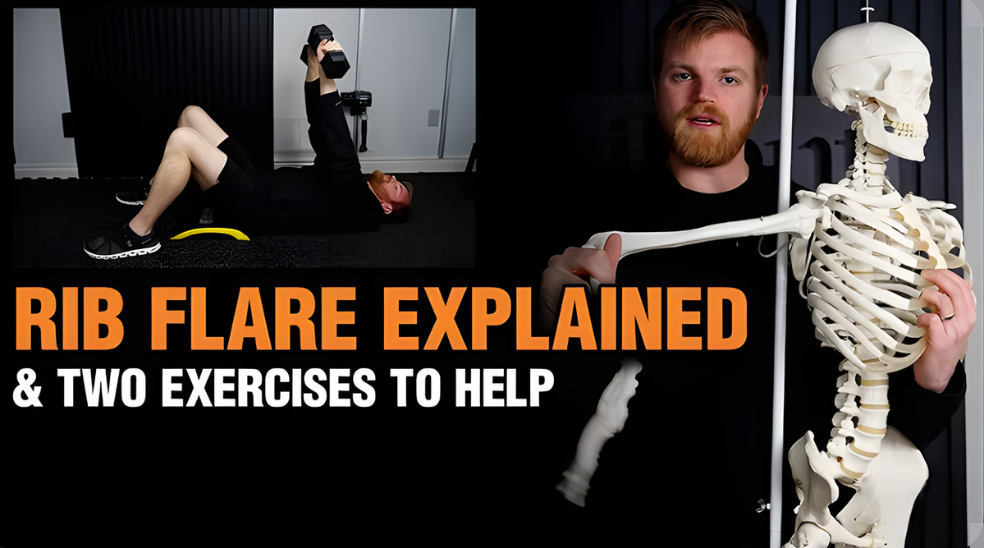
And if you’re looking for a structured program that helps address compensations like this while still allowing you to train, the Rebuild Blueprint walks you through a 12-week progression designed to restore position, improve strength, and build movement that actually carries over to the gym and real life.