
How to Restore Hip Internal Rotation Without Forcing Range
Jan 08, 2026
Hip internal rotation is one of the most commonly limited movements I see, both in active adults and in athletes. After more than 15 years in this industry, it is the movement restriction that shows up the most often and causes the most downstream issues.
When hip internal rotation is limited, it does not just affect the hip. It impacts how you load the foot, how you push off the ground, how you hinge, squat, and run, and how the pelvis and rib cage organize under load.
To improve hip internal rotation, we first need to understand why it is limited in the first place. In my experience, there are three primary reasons this happens, and all three are rooted in pelvic position.
Why Hip Internal Rotation Gets Limited
1. The pelvis dumps forward
One of the most common patterns I see is an anteriorly tilted pelvis.
When the pelvis dumps forward, space in the front of the hip decreases. The femur shifts into a more externally rotated position, which immediately limits internal rotation. As a result, the body loses the ability to load the foot and push off the ground efficiently.
To compensate, people often shift their weight toward their toes. You will see increased arching through the lower back or rib cage as the body tries to create force through extension instead of rotation.
Hip internal rotation is critical for pushing into the ground and loading the foot. When that option is not available, the body finds another way.
2. Compression at the back of the pelvis
When the pelvis dumps forward, something else happens at the same time.
The sacrum moves closer to the sit bones, effectively squeezing the back side of the pelvis. This compression limits not only hip internal rotation, but also hip flexion.
This is the pattern you often see in people who constantly squeeze their glutes or stand in a subtle swayback posture. They may look strong, but they are stuck.
Common complaints associated with this pattern include:
-
Pinching in the front of the hip
-
Piriformis tension
-
SI joint discomfort
These symptoms are not always caused by compression, but this pattern frequently contributes to them.
3. The pelvis turns away from one side
The third pattern is usually a combination of the first two.
When the pelvis both dumps forward and rotates away from one side, space disappears on both the front and back of the hip. The femur and pelvis move closer together, further limiting internal rotation.
The key point here is that all three patterns are related. The difference is which one is dominant. That distinction is what determines which exercise will be most effective.
How to Improve Hip Internal Rotation
The solution is not stretching harder or forcing the hip into rotation.
To restore hip internal rotation, we need to:
-
Reposition the pelvis
-
Create space between the femur and pelvis
-
Restore the ability to load the foot and rotate through the chain
Below are three strategies I use to address these limitations.
1. Cross-connect drill
The first drill addresses a pelvis that is dumped forward and missing internal rotation.
By grounding the outside heel and the ball of the big toe, the foot and shin naturally begin to rotate inward. This rotation travels up the chain and helps restore hip internal rotation.
Key cues include:
-
Keeping the belt line gently connected to the floor
-
Avoiding excessive core bracing or lower-back arching
-
Reaching the opposite arm slightly across the body to reinforce rotation
You should feel the lower glute working, not squeezing aggressively, but maintaining tension. That is how you know you are in the right position.
2. Cross-body hinge
The second strategy uses a cross-body position combined with a hinge.
By placing the body in a cross-body stance, you are forced to load the inside edge of the foot. This creates internal rotation from the ground up. As you hinge, you open space between the femur and the sit bone, allowing the back of the pelvis to decompress.
Important points here:
-
Drive the knee forward in line with the toes
-
Maintain contact through the inside edge of the foot
-
Keep the knee bent to avoid aggressive glute squeezing
This drill helps restore space while maintaining control.
3. Adductor-focused work
Adductors play a major role in hip internal rotation, especially the upper adductors that attach close to the pelvis.
When these muscles engage properly, they help open the bottom and back of the pelvis, putting the hip socket in a position that allows internal rotation to occur.
Key elements include:
-
A slight forward lean to encourage a hinge position
-
Pulling up on the handles to drive the sit bones down
-
Maintaining an isometric squeeze while controlling the breath
Adduction is internal rotation. When programmed correctly, it becomes one of the most effective ways to restore space and control at the hip.
Limited hip internal rotation is rarely about tight muscles or weak hips. It is about how the pelvis is positioned and how the body is using the ground.
Once you understand which pelvic pattern is driving the limitation, exercise selection becomes much clearer and far more effective.
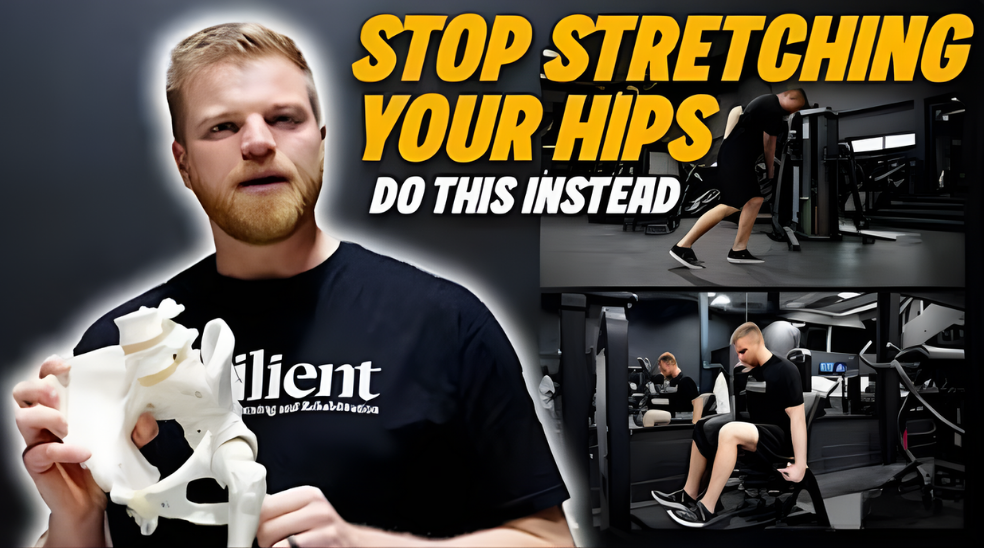
If you want to see these drills demonstrated and understand how to apply them properly, you can watch the full video: Why Your Hip Internal Rotation Is Limited (And How to Fix It).
And if you want a structured system that builds on these concepts, the Resilient Posture Program includes over 40 exercises broken into three progressive phases designed to improve hip and shoulder mobility through smarter positioning, not forcing range.

