
Rounded Shoulders Explained: Why Stretching and Rowing Often Miss the Mark
Feb 12, 2026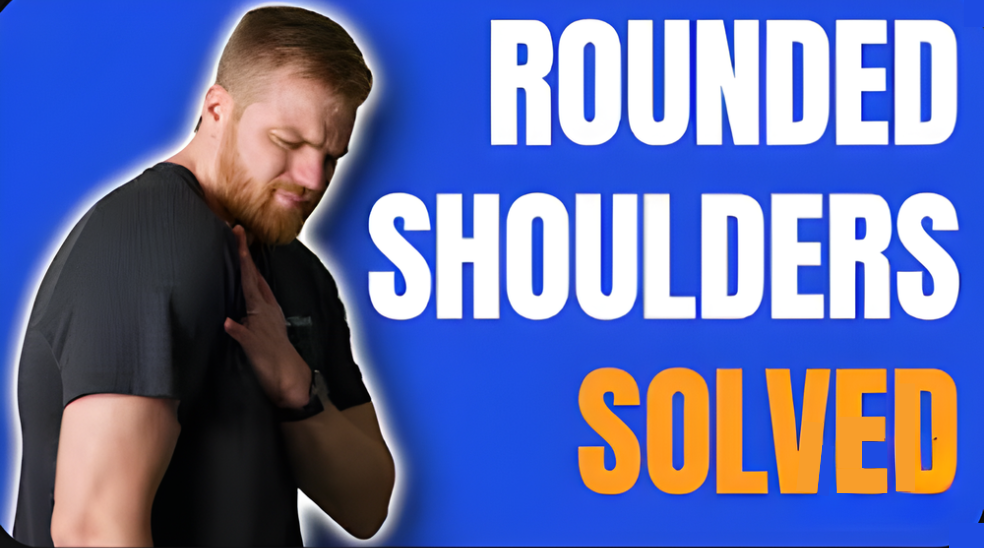
Rounded shoulders are one of the most commonly discussed posture issues, and yet the advice around them rarely changes.
Stretch your chest.
Strengthen your upper back.
Do more rows.
That explanation sounds reasonable. It just doesn’t fully explain why so many people stretch consistently, row religiously, and still feel stuck.
The issue usually isn’t effort, it’s how the body is organizing itself to stay upright.
Rounded shoulders are a strategy, not a flaw
In most cases, rounded shoulders are not the result of weak muscles or laziness. They’re a response to where the body’s center of mass lives.
When someone spends a lot of time shifted forward over their toes, everything upstream has to adapt. The pelvis tends to tip forward, the ribs flare, and the torso drifts ahead of the hips.
Now the body has a problem.
If gravity keeps pulling you forward, how do you stop yourself from falling?
You round.
That shoulder rounding is the body’s way of pulling itself back into balance. It is a stability strategy, not a mistake.
Why “strengthen the back” often backfires
This is where things get counterintuitive.
In a forward-shifted posture, the muscles between the shoulder blades are often already stiff and loaded. They are not long and weak. They are long and tense.
When you cue someone to squeeze their shoulder blades or load them up with rows in this position, you are not releasing tension. You are often adding more.
That’s why rowing patterns frequently look messy in people with rounded shoulders. No matter how much cueing you apply, the shoulders keep drifting forward. The issue is not a lack of strength. It’s the position the ribcage is stuck in.
Simply pulling the shoulder blades together does not change that orientation.
Ribcage position changes everything
Once you shift the focus away from the shoulders and toward the ribcage, things start to make more sense.
When the ribs are stacked more effectively over the pelvis, the shoulders no longer need to round forward to create stability. The system doesn’t have to fight gravity as aggressively.
This is also why certain rowing variations suddenly clean things up. Cross-body rows, for example, often look and feel better not because they magically strengthen different muscles, but because they help reposition the ribcage.
The movement itself encourages better stacking.
Exercise selection matters more than stretching harder
Another common mistake is assuming that posture improves by forcing muscles to stretch.
Aggressive pec stretching might feel good in the moment, but it rarely creates lasting change. The goal is not to tear tissue or force range. The goal is to create space.
This is where frontal plane and diagonal movements tend to shine.
Straight front or straight side arm patterns often reinforce the same tension strategies. Working in that middle ground, roughly 45 degrees between front and side, allows the front and back of the body to expand at the same time instead of competing with each other.
Side-lying work, diagonal reaches, and positions that allow the sternum to lift naturally tend to restore posture more effectively than static stretches.
You are not forcing the body into a shape. You are giving it an option it can actually use.
A different way to think about posture
Rather than asking what needs to be stretched or strengthened, a better question is:
What is the body doing to keep itself upright?
When you answer that, exercise selection becomes much clearer.
This perspective opens up far more options than the traditional stretch-and-row approach and explains why so many people struggle to make lasting posture changes.
If you want to see these concepts broken down visually, including exercise examples and positional cues, you can watch the full video here.
And if you want a structured way to apply this approach, the Resilient Posture Program walks through it step by step. Phase 1 focuses on restoring space on both the front and back of the body by improving ribcage and pelvis positioning, without forcing stretches or relying on generic cues.

