
The Real Cause of Front Shoulder Pain During Pressing (Most Miss This)
Apr 30, 2026
If you get pain in the front of the shoulder during pressing movements, the instinct is usually to blame the rotator cuff, stretch the pec, or take some time off and see if it settles. And sometimes that helps short term.
But if it keeps coming back, there's a good chance you're treating the symptom and not the cause.
Here's what's actually driving it.
Why pressing hurts the front of the shoulder
Pressing movements, across all variations, require the shoulder to internally rotate. That's not a cue or a technique point. It's just the mechanics of the motion.
When that internal rotation isn't available, the body compensates. The shoulder rolls forward. It hikes up. Or it rotates away from that side entirely. When any of those things happen, the arm bone and shoulder socket stop moving in sync with each other. That mismatch puts excessive stress on the front of the joint, and that's where you feel it.
There's a clinical test called the Hawkins-Kennedy test that looks specifically at this. It measures the ability to internally rotate and adduct the shoulder, which is essentially what every pressing rep demands at mid-range. If that motion is restricted, pressing is going to expose it every single time.
The ribcage connection most people overlook
Here's where it gets interesting. The shoulder doesn't rotate in isolation. Whether or not that rotation is available depends heavily on what the ribcage is doing underneath it.
Think about the front of the chest. For the shoulder to freely rotate, there needs to be space between the sternum and the shoulder. Those two surfaces need to be moving away from each other. When they start moving toward each other instead, that space closes off and internal rotation goes with it.
A really common driver of this is a flared ribcage. When the ribs flare, the ribcage widens side to side. If you think about it from a top-down view, instead of a more triangular shape with an open front, you get a rounder, wider shape that crowds the front of the shoulder. Now the space the shoulder needs to move just isn't there, and every pressing rep becomes a stress test on the front of that joint.
What to actually do about it
When you address this properly, you're working on three things at once: creating space at the front of the shoulder, improving the ability to bring the arm across the body, and making sure that motion is coming from the shoulder itself rather than the ribcage compensating.
The first exercise uses a foam roller placed under the armpit with the arm lined up along the roller and the legs crossed. The crossed leg position keeps the hips and ribcage stacked and limits how much the pelvis can roll forward. From there, you inhale as you roll forward onto the front of the ribcage, and exhale as you roll back. The goal is to feel that back part of the shoulder releasing. Adding internal rotation of the wrist into the ground as you roll makes this even more effective because you're getting that shoulder rotation while simultaneously working on ribcage position.
The second exercise is a cable chest fly set up in a specific way. Having the foot on the working side forward turns the ribcage slightly away from that side, which opens the front of the chest. Keeping the elbow slightly bent, not fully extended and not excessively bent, allows the motion to happen at the shoulder joint rather than being absorbed elsewhere. Staying within 90 degrees of shoulder flexion is key here because that's where the internal rotation demand is highest.
The third exercise is a cable tricep pushdown variation. The cable goes at a high position, the outside foot steps out, and the elbow is brought in line with the big toe reaching toward the ground. The palm turns down as far as possible without letting it twist. From there, keeping the elbow where it is, you breathe out and pull the cable down toward the big toe while maintaining that internal rotation. There will be a point where the hand wants to turn out. That's the end range. The goal is to reinforce the rotation through the full movement because this position turns the chest away from that side and drives internal rotation all the way up the chain.
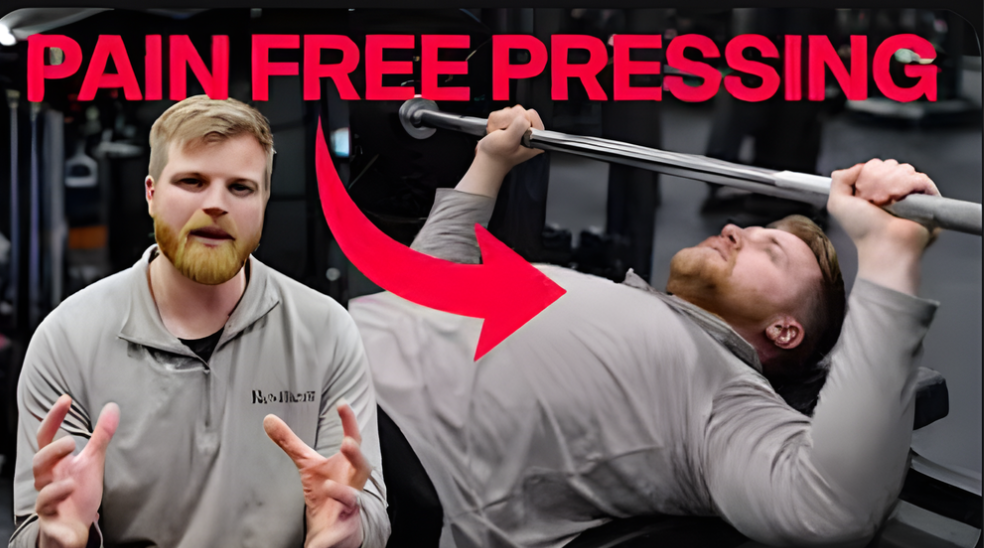
Want to see all three of these in action? I walk through each one in the video below, including how to set up and cue them.
The bigger picture
Shoulder pain during pressing is one of the most common issues coaches and trainers deal with, and most of the time the fix people reach for doesn't touch the underlying position problem. When you understand how the ribcage, shoulder joint, and available rotation all interact, you stop guessing and start actually solving it.
If you want to build that kind of systematic understanding across the whole body, the Foundations of Biomechanics course is where to start.

