
Why You Get Hip Impingement When Squatting (And How to Fix It)
Apr 27, 2026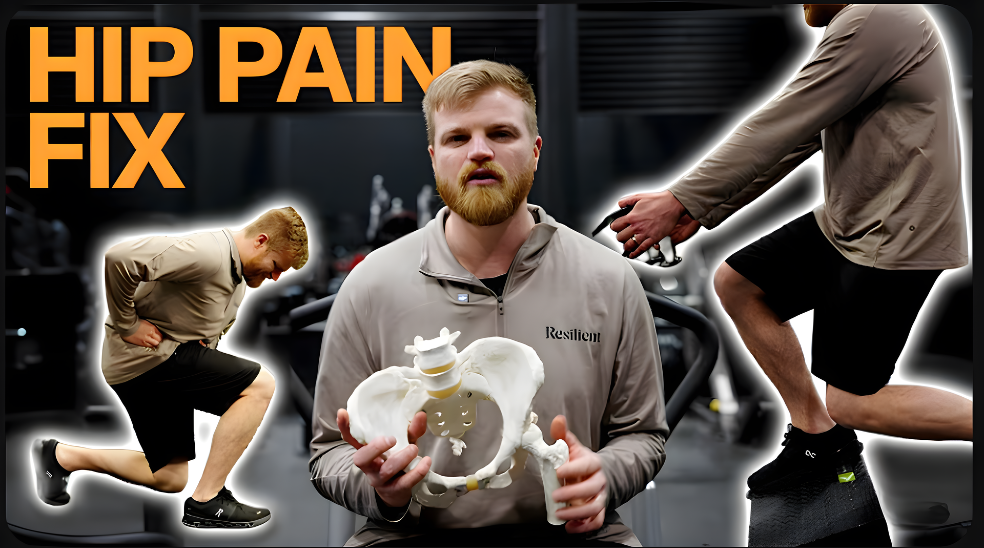
If you or your clients feel a pinching sensation in the front of the hip during squats, split squats, or any deeper hip flexion, the first instinct is usually to blame the hip joint itself. Maybe it's a structural issue. Maybe the joint just can't flex that far.
But in most cases, it's not a structural problem. It's a position problem.
What's actually causing the pinch
The hip socket doesn't sit in a fixed position. It faces a specific direction depending on how the pelvis is oriented. When the pelvis is more open, think of it like a bowl tilting forward, the sockets end up facing more downward and out. That places the femurs in more external rotation, which works fine until you try to flex the hip through a deeper range and run out of internal rotation.
At the mid-range of a split squat, or around 90 degrees of hip flexion, the femur needs to internally rotate as the pelvis closes down over it. If that rotation isn't available, the femur runs into the front of the hip instead of clearing through it. That's the pinch.
Why the body compensates around it
When internal rotation isn't available at the hip, the body finds it somewhere else. The pelvis might tip forward. It might rotate away from that side. You'll sometimes see a leg swing outward toward the shoulder during hip flexion instead of tracking straight up. That's not a random quirk. That's the spine and pelvis doing the work the hip can't.
Left unaddressed, this pattern puts tissues in positions they weren't designed to sustain under load. Over time, that's how hip impingement becomes a recurring issue rather than an occasional annoyance.
Three exercises to fix it
1. Foam roller pelvic reset
The first step is reshaping the pelvis so the socket can actually face the right direction. If the pelvis is open like a flower, you need to close it before anything else will work.
Lie on your side with a foam roller positioned just below the crest of your pelvis, along the belt line. You don't want it too low on the hip bone, and you don't want it above the crest. For a right hip issue, take the right knee and position it at about 45 degrees, not too high and not tucked underneath you. Support yourself on your arm with the bottom leg open.
From here, breathe out as you roll forward and bring your arm and knee down toward the ground. Take a breath in at the bottom. The key detail: keep the bottom knee and ankle on the ground. A lot of people want to move the knee along with the motion, but if you let that happen you're not actually changing the shape of the pelvis. Lock that knee down, breathe out, roll forward, and let the pelvis do the work.
2. Heel-elevated cable split squat
Once you've started to shift the pelvis into a better position, you need to reinforce it through a loaded movement. The heel-elevated cable split squat does exactly that.
The heel elevation opens up the front of the ankle, but more importantly it shifts your weight forward toward the toes, which means you have to actively push back into your heel. That heel loading is what opens up the back of the hip and creates space on both sides, which is exactly what's compressed in someone dealing with hip impingement.
Holding the cables is intentional too. The cables pull you forward, so you have to push back, open up through the shoulder blades, and stay in your heel rather than collapsing into your toes.
As you descend, let the cables pull you forward while driving the knee forward and staying vertical. Breathe in on the way down, breathe out as you push up. One important cue: don't let the knee come back as you rise. Keep it forward throughout. You should feel a lot of inner quad and glute. Only go as deep as you can control. If you're leaning back and losing your heel at the bottom, you've gone too far.
3. Crossover step-up
The crossover step-up reinforces internal rotation through the push-off pattern, which is where a lot of people notice the biggest difference.
The reason it works is mechanical: crossing the leg across the body forces the hip into internal rotation. People who are missing that rotation will naturally want to let the knee flare out as they come up, which is just the compensation showing up in a different exercise.
The setup matters. You don't want to cross over so much that your knee caves inward and your foot starts to turn in. And you don't want so little crossover that you're not actually driving the rotation. Find the middle ground, lean slightly toward the stepping side as you bring your arm across, and then drive up. Keep a slight bend in the knee at the top rather than fully extending, and control the descent before going again. The goal is to keep the knee as stationary as possible through the movement so the motion is actually happening at the hip.
This exercise loads the anterior glute med, inner adductors, and inner hamstrings, all of the structures that support internal rotation and help keep the pelvis from rotating away under load.
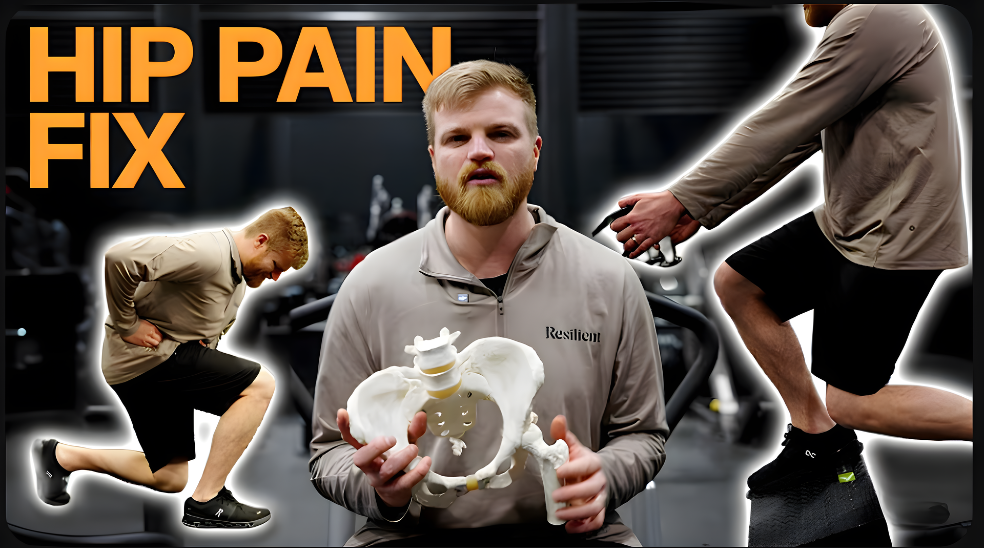
If you want to see all three demonstrated, I walked through each one in this week's video.
Watch: Fix Hip Impingement When Squatting (Do This)
The bigger picture
Hip impingement is an internal rotation issue. And internal rotation is a pelvis position issue. Once you start reading it that way, it stops feeling like a mysterious joint problem and starts giving you something concrete to work with.
If you want to get better at this kind of thinking across the whole body, not just at the hip, that's exactly what we work through inside EVOLVE. Save your spot in the next cohort.

