
Why Your Client Keeps Shifting to One Side in a Squat
Apr 16, 2026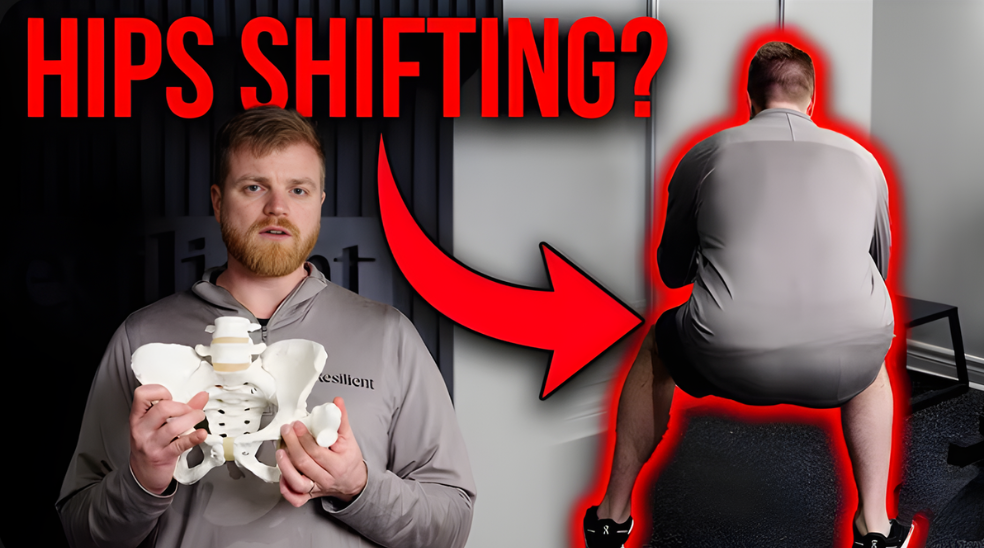
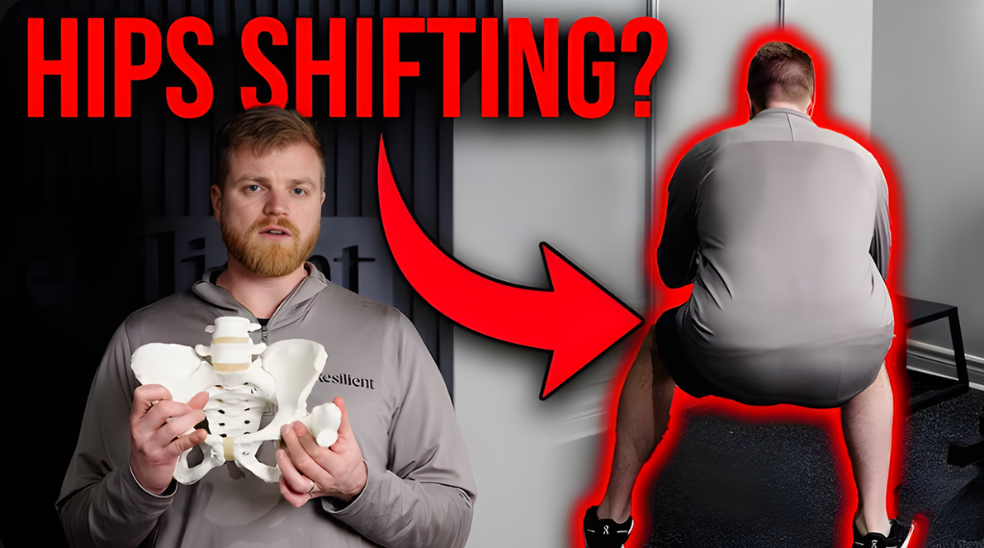
A hip shift in the squat is one of the most common compensations you'll see as a coach or clinician. And it's also one of the most misread.
Most people assume it's a strength imbalance. One glute isn't firing, one side is weaker, so the hips drift. The fix becomes more single-leg work, more glute activation, more loading on the affected side.
But that's treating the symptom. If the hips are shifting, there's a position problem underneath it that's worth understanding.
What's actually driving the hip shift
Let's use a common example: a client whose hips shift to the right during their squat.
What that pattern tells you is that the right hip is running out of room, specifically hip flexion and internal rotation. When hip flexion is limited, the pelvis starts to dump forward on that side. When internal rotation is limited, the pelvis begins to rotate away from it. Put those two things together and you've got a pelvis that's both tilting and turning, and the body compensates by finding the motion somewhere else, usually the spine.
This is why a hip shift isn't just a hip problem. It's a full pelvis rotation with a spinal component attached to it. The tissues being loaded are now working from a position they weren't designed to sustain under load. That's how clients end up presenting with SI joint discomfort, proximal hamstring irritation, or a vague hip pain they can't quite locate. It all traces back to the same pattern.
When does it actually become a problem
A hip shift by itself isn't always a red flag. Plenty of people move asymmetrically without issue.
It becomes a problem when you keep loading it without addressing what's driving it. Over time, the tissues absorbing that compensated load accumulate stress, and eventually something gives. The goal isn't to panic every time you see a hip shift. It's to recognize it as information and decide what to do with it.
The fix isn't a cue
A lot of coaches will try to cue their client out of the shift in the moment. "Keep your hips square." "Don't let that side drop." And sometimes that works short term.
But if the underlying position hasn't changed, you're just asking the client to fight their own mechanics every rep. The more durable fix is restoring the motion that's missing so the pelvis can sit more neutral going into the pattern naturally.
That means two things. First, decompressing the hip so it can actually access the flexion and internal rotation it's been avoiding. Second, reinforcing that position progressively against gravity before you reload the squat.
Two exercises to address it
For the first exercise, the goal is to decompress the hip and start restoring pelvic position on the ground before asking the body to manage it upright. A lateral position with some breath work and a light wall press can go a long way toward shifting the pelvis back toward neutral.
For the second, you want to reinforce that position more upright, against gravity, with enough load to feel the hip working without letting the low back compensate. A kneeling cable variation works well here because the cable in front keeps the ribcage from flaring while the kneeling position drives hip extension on the affected side.
Both of these work well as warm-up drills before you load the squat pattern in a session.
I walked through both of these in detail in this week's video if you want to see them in action.
The bigger picture
A hip shift is a window into how the pelvis is oriented and how much motion is actually available at the hip. Once you start reading it that way, it stops feeling like a problem to fix and starts feeling like useful information.
That's the foundation of assessment-based coaching: understanding what a compensation is telling you so you can respond to it intelligently rather than just loading around it.
If you want to build that skill across the whole body, not just squat mechanics, the Foundations of Biomechanics course is a good place to start. It covers how to read movement, understand why compensations happen, and build programming that actually addresses the underlying cause.

