
How to Make Any Squat Target Your Glutes
Sep 10, 2026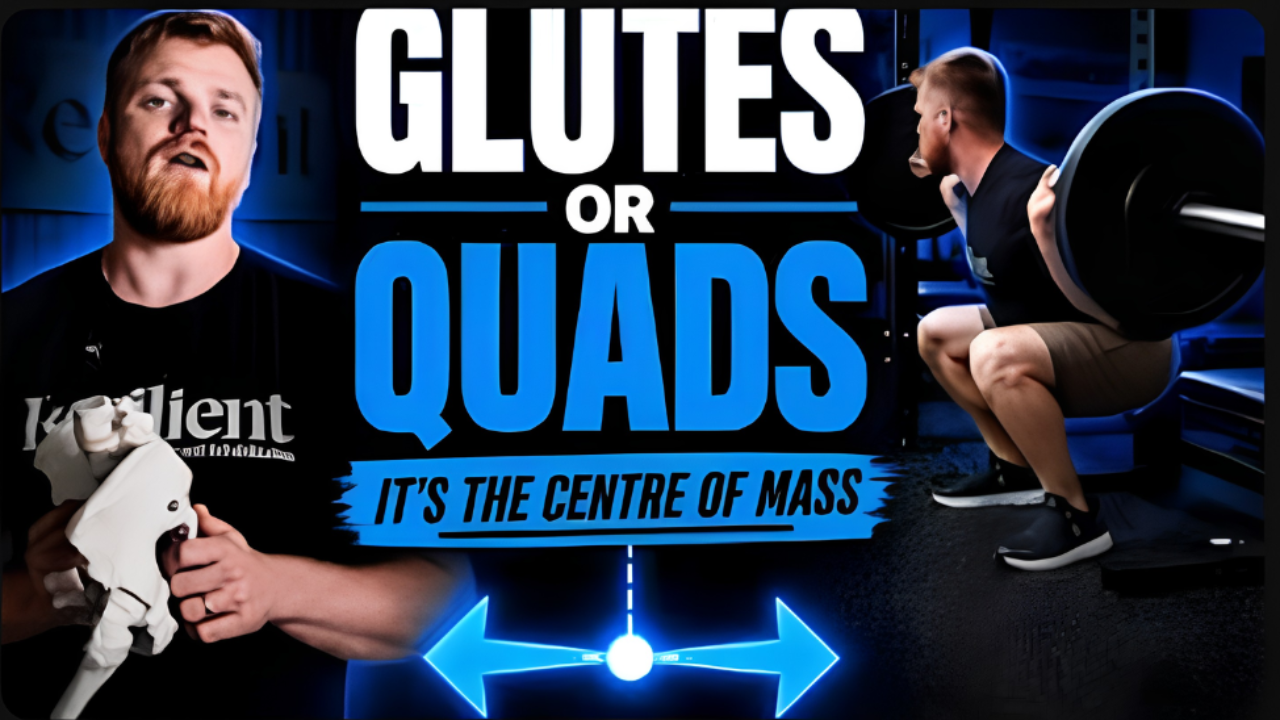
One of the most common ways people categorize exercise is by sorting it into quad dominant or glute dominant. And when a coach wants to shift the emphasis from one to the other, the default move is usually to swap the exercise entirely. Squat feels quad heavy? Switch to a deadlift or a bridge to get more posterior chain.
But there's a simpler lever sitting right in front of us, and it doesn't require changing the movement at all.
The Center of Mass Is the Real Driver
Most of us assume we need a completely different movement pattern to bias the glutes over the quads. If a squat feels quad dominant, the instinct is to reach for a deadlift or a bridge to get more posterior chain involvement.
But the center of mass is doing more work here than the exercise category itself. Shift it, and you shift which muscles pick up the load, even inside the exact same lift.
Squats: Rocket Ship vs. Airplane
Take the squat. If the bar sits more in front of the body, like in a front squat or a safety bar squat, or if the hands and elbows are positioned in front, the center of mass naturally shifts back. That keeps the lifter over the middle of the foot or closer to the heel, which produces a more vertical squat path. Think of it moving up and down like a rocket ship.
A traditional back squat does the opposite. It pushes the center of mass forward, which sends the body into more of a horizontal path, like an airplane. That forward, horizontal pattern is what pulls the glutes into the lift more heavily.
It's the same basic squat pattern from start to finish, but a different bar position sends the load to a different dominant muscle group.
Split Squats: Front Foot Elevated vs. Rear Foot Elevated
The same principle shows up in split squat variations. With a rear foot elevated split squat, the back leg sits up on a surface, which shifts weight forward onto the front leg. That forward shift pushes the movement into the same airplane pattern as the back squat, loading the glutes and sitting the hips back.
Flip it to a front foot elevated split squat, and the weight shifts back onto the rear leg instead. That produces a more vertical path, which pulls more of the work into the quads. The glutes are still involved either way, but where the load lands most depends on which foot is elevated.
I break down exactly how to coach both of these variations, along with the squat comparison over on YouTube, which is worth watching if you want to see the bar and foot positioning in action rather than just reading about it.
Programming With This in Mind
The takeaway for programming: instead of thinking in terms of pairing a quad exercise with a glute exercise, or a pushing movement with a pulling movement, you can hit different muscle groups by adjusting how the center of mass moves within a single exercise. That gives you more variation to work with using fewer total movement patterns, and it's a useful thing to keep in mind the next time a client's program feels like it needs a full overhaul when a bar or foot position change might do the job.
If you want the full progression for squats, hinges, presses, pulls, and every other major variation, along with how to program and modify each one, I cover all of it inside Roadmap to Exercise Selection - where I break down each exercise, how to program it, how to modify it, and the compensations to watch for along the way.

