
Why One Foot Turns Out (And What the Pelvis Has to Do With It)
Oct 05, 2026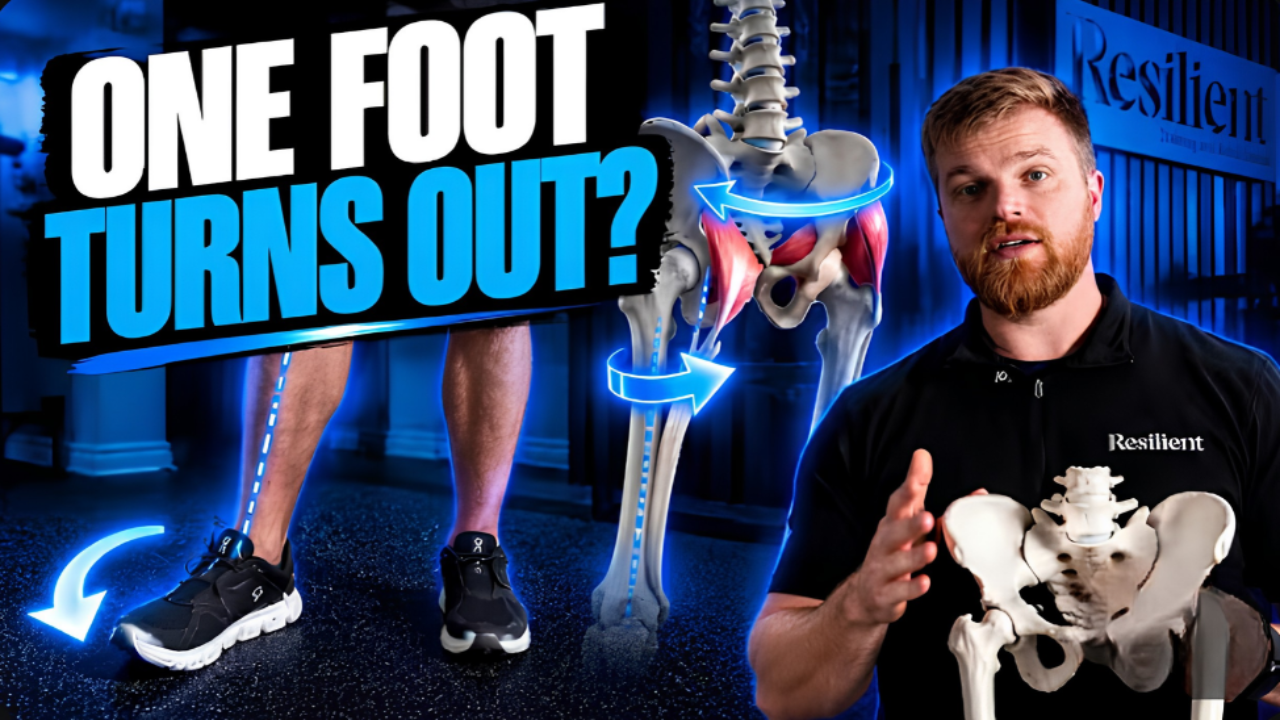
Have you ever noticed a client standing or sitting with one foot turned out while the other points straight ahead? A lot of people treat it as a foot issue. In most cases, the rotation starts higher up, at the pelvis and hip.
In this post, I'll walk through what's happening mechanically and share two exercises I use to restore the internal rotation that's usually missing on that side.
The Rule of Thumb I Teach in EVOLVE
One of the rules of thumb I teach coaches in the EVOLVE Biomechanics Mentorship is simple: whichever foot turns out, that's the direction the pelvis is turning.
So if a client's right foot always points outward, the foot is usually following what's happening above it. The whole pelvis and femur are rotating toward the right, and that's what creates the turnout you see at the ground.
This becomes easy to spot when someone lies on their back. The left side of the pelvis drifts forward, everything looks like it's rolling toward the right, and then the leg follows.
What's Missing: Internal Rotation
For that pattern to stop, the right hip needs to be able to internally rotate.
Think of it this way. If the pelvis is always turning right, something has to act as a brake so the body can face forward. Without that brake, the pelvis keeps rotating and the leg keeps turning out along with it.
Internal rotation at the right hip is the brake.
When a client has access to it, they can stop that rotation, and the foot can settle back toward a more neutral position.
Turning the Pelvis Around the Femur
There are two ways the pelvis can rotate, and the difference between them matters a lot here.
In the first, the pelvis and lower back move together as one unit. The lower back arches, the whole pelvis rotates, and the leg turns outward with it. This is the pattern we tend to see in clients with that turned-out foot.
In the second, the femur stays in place and the pelvis turns around it, back into the hip. This creates space in the back of the hip, which is what allows internal rotation to happen and keeps the foot pointing straight ahead.
So the exercises below have two jobs. They build a pelvis that can rotate over the femur, and a femur that can internally rotate to resist excessive turning.
Exercise 1: Exaggerated Arm Bar
The first exercise is an exaggerated arm bar. By rolling onto the right hip, we can keep the right foot from turning out while the pelvis rolls around it.
You'll hold a dumbbell or kettlebell in the left hand with the right arm open and the palm facing the ceiling. From there, march the left leg up and roll toward the right, turning the hip as far as you can toward the ground while the weighted arm stays up.
Most people go too far on this one. The goal is to reach only as far as you can before the right foot starts to turn up, so I like to cue keeping the outside ankle bone and the outside of the knee on the ground. Once you're there, take a big breath in, breathe out, and reach the left knee forward. You should feel a big stretch in the back of the left hip and across the left side of the chest.
The left arm has a specific role. Holding the weight up keeps the ribcage back longer, which stops the whole pelvis from swinging right as one unit. That lets the rotation come from the hips, with the right hip internally rotating to resist the turn.
Exercise 2: High Cable Press Across
The second exercise takes that internal rotation and uses it to put force into the ground as the body shifts toward the other side. Since the pelvis is turning right, we want to help it face more toward the left.
Set the cable at its highest position and bring the handle underneath the armpit to create more space. The knees sit a little higher than normal, around two yoga blocks, with your weight shifted onto the inside of the right leg and the left leg out.
From there, push down and reach across toward the left side, breathing out as you press. Keep the shoulder from rounding too far back on the return. I stop when my elbow reaches about where the ribcage ends.
This one is done on the side where the foot turns out, so the client learns to push themselves back toward the other side.
Both of these exercises are much easier to learn when you can see them, so watch the full video for my complete setup and cueing before trying them with a client.
Bringing It Together
When one foot turns out more than the other, the cause usually sits at the pelvis or somewhere else in the system. Restoring internal rotation on that side, and then teaching the body how to use it to shift back toward the middle, gives clients a way out of that rotated position.
If you want to dig into more content like this, the EVOLVE Biomechanics Mentorship breaks down a range of compensations, my exact assessment process for identifying them, and what to do about each one.

