
Why Your Client's Hip Keeps Hiking Up (And It's Not a Glute Problem)
Jun 24, 2026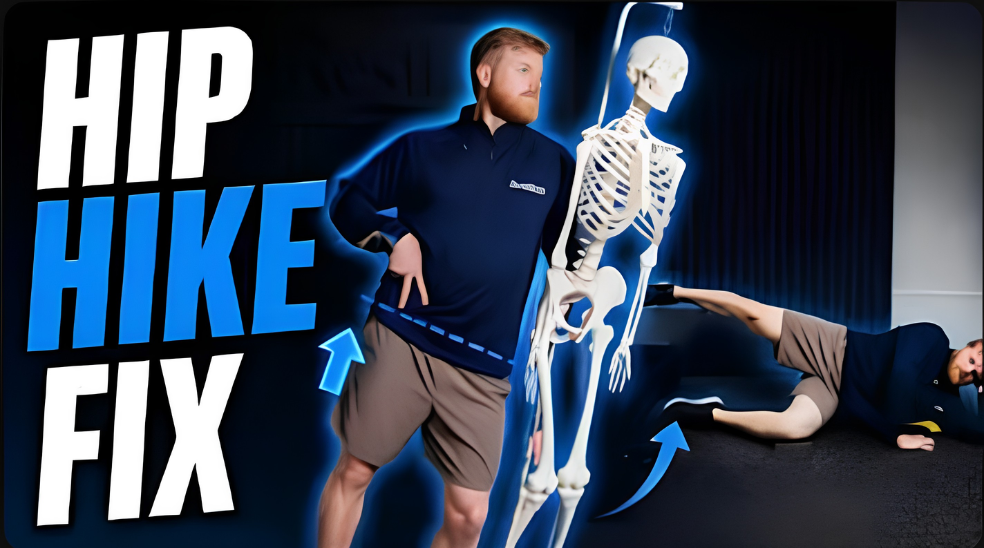
A right hip hike, or lateral pelvic tilt, is one of the most common compensations you'll see walk through your door. The usual instinct is to chalk it up to weak glutes and program around that assumption. Most of the time, that's not actually what's happening.
To fix it, you have to understand why it's happening in the first place.
What's Actually Causing the Hip Hike
The pattern usually starts with rotation, not weakness.
In a lot of clients, the pelvis turns toward the right. To keep the eyes facing forward, the rib cage has to counter rotate back toward the left. Depending on how much tension, compensation, or pain someone is dealing with, this rotation can show up as a mild shift or a much more exaggerated pattern.
On its own, this rotation isn't necessarily something that needs to be addressed. Plenty of people walk around with some degree of it and never feel a thing. It becomes a problem when it starts to create pain or discomfort, which is usually when someone ends up in your gym or clinic looking for help.
Here's where it gets interesting. When the pelvis turns toward the right, the femur has to internally rotate to keep up. If it can't, the foot starts to roll outward. To compensate for that, the lower back arches. And to stop the whole pattern from tipping the body outside of a stable base, the shoulder drops and the hip hikes up.
In other words, the hip hike isn't the problem. It's the body's solution to a rotational problem happening somewhere else. Think of it this way: the rotation is pushing the body wider than hip width with every step. The hip hike is what keeps the foot from rolling all the way out and the person from falling over.
That's the short version. There are actually a few different ways a right lateral pelvic tilt can develop, and an equal number of ways a left lateral pelvic tilt shows up. This article focuses on one specific pathway: a pelvis turning right combined with a hip hike, driven by missing motion at the hip and the shoulder.
A Simple Exercise That Targets This Pattern
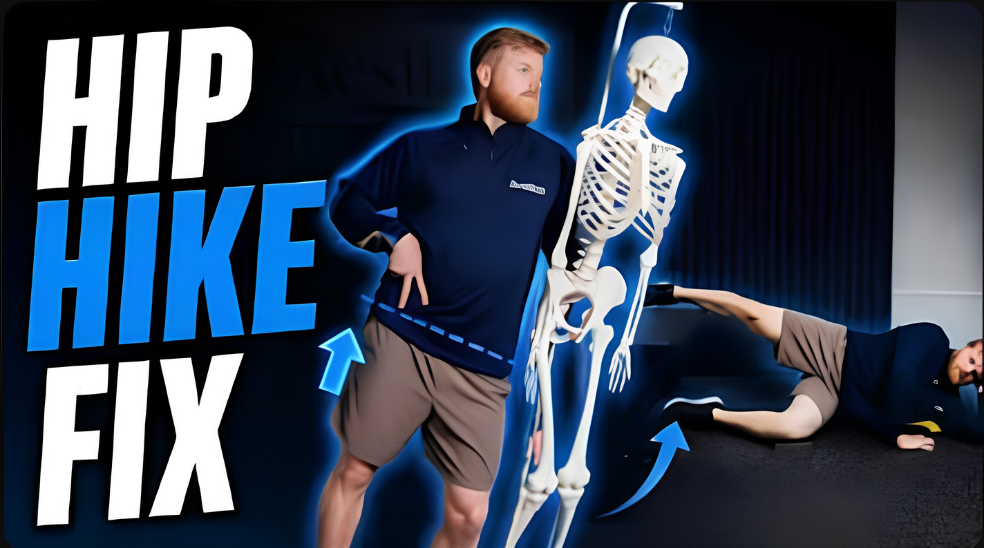
One of the most useful exercises for this specific presentation is a left side lying, right leg reach.
The logic behind it: if the pelvis can't internally rotate and it's stuck turned to one side, this position is built to help it rotate back in, while also creating more space between the rib cage and the hips. Lying on the left side adds another piece, since it lets the body rotate into the left hip at the same time. You're addressing multiple parts of the pattern in a single position.
Here's how to set it up:
Positioning. Lie on your left side and place an ab mat or folded towel under your ribs. The goal is for your ribs to sit slightly in front of neutral, not so far forward that the front of the rib cage is on the pad, and not so far back that you're resting on the back or side of the ribs. You'll find that position naturally by reaching the top leg, which will turn the hips slightly forward.
Most people default to sitting too far back in this position. Reaching the leg forward, and turning the femur forward as you reach it out of the hip socket, helps correct that.
The ramp. Place a small ramp or wedge under your bottom leg. This lets you turn further into the back of that hip. Without it, people tend to over rotate, and you'll notice the bottom ankle lift off the ground. That's a sign there isn't enough space to rotate into that hip yet. With the ramp in place, the heel can stay relaxed on the floor while the back of that hip opens up.
The reach. From this position, hands turned, reaching out of the socket, take a breath in. As you breathe out, reach the top leg as if someone is gently pulling it out of the socket. Breathe in, breathe out, reach again. You should feel the glute on that side engaging close to the joint, not the larger muscle higher up. Keep breathing and reaching, creating a little more space each round.
For an added stretch, you can bring your top arm overhead and reach it toward the ceiling as you continue breathing and reaching the leg.
The Caveat Worth Remembering
Doing this exercise won't automatically resolve every right lateral pelvic tilt you see. Everyone arrives at that pattern through a slightly different path, and there are multiple ways the body can produce the same visual compensation.
This exercise addresses one specific version: missing internal rotation at the hip paired with a hip hike. If you want to understand the other pathways that lead to a right or left lateral pelvic tilt, and how to assess which one you're actually looking at, that's exactly the kind of distinction we work through inside EVOLVE.
If you'd rather watch this explained in real time, including the cueing and setup details, check out the full breakdown here.
Want to Go Deeper on Assessment?
Spotting a hip hike is one thing. Knowing which of the several underlying patterns is driving it, and choosing the right exercise for that specific client, is a different skill entirely.
That's the gap EVOLVE is built to close. It's a 10-week live mentorship for coaches, trainers, and therapists who want a real system for assessment and exercise selection, not just a growing list of exercises to try when something looks off. This cohort also includes a brand new bonus week on business foundations, covering social media, client acquisition, and retention.
Early bird pricing is live right now, $100 off, through July 2.

